Why Your Cat Won’t Listen: The No/Yes Rule That Fixes Almost Every Behavior Problem
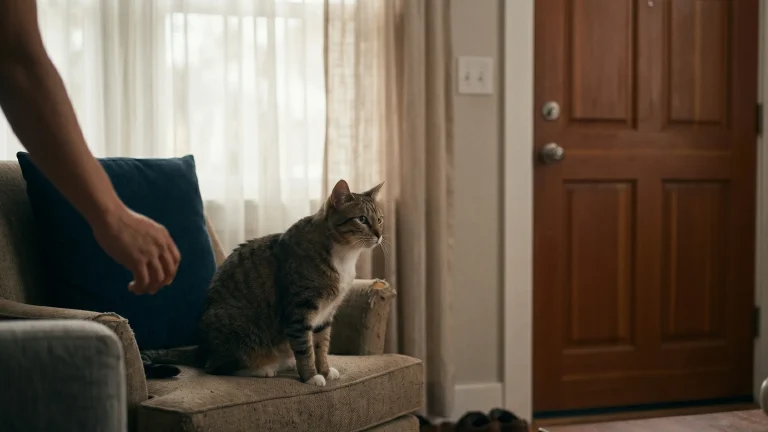
It’s a scene played out in living rooms everywhere: you’re prepping dinner and your cat leaps onto the counter for the fifth time. You point, you yell, maybe you reach for the spray bottle — and for one glorious second, they scatter. Ten minutes later? They’re right back up there, staring you down.
It’s easy to feel like your cat is being stubborn, vengeful, or just plain rude. But here’s the truth: your cat isn’t a jerk. Traditional punishment fails because it damages your relationship without ever changing the behavior. To fix this, you need to stop “laying down the rules” and start using the No/Yes method — the framework that finally makes your cat’s instincts and your sanity coexist.
Your cat is not being “bad.” They are acting on deep biological instincts. Every behavior problem described below has a root instinct driving it — and a valid, home-friendly outlet waiting to replace it. Punishment alone addresses neither.
The Spray Bottle Trap: Why Punishment Teaches Fear, Not Behavior
Most cat owners learn early that a sharp “Hey!” or a spray bottle squirt stops the bad behavior instantly. The problem? That relief is an illusion.
Cats don’t connect an unpleasant sensation to their own action. Instead, they connect it to you — the person holding the bottle. The result is what behaviorists call stealth behavior: your cat learns that the counter is only “dangerous” when you’re in the room. The moment you head to bed or leave for work, they’re right back at it.
“They’re afraid of this which is attached to this which is attached to this… It’s you they’re afraid of, not the act.”— Jackson Galaxy, Cat Behaviorist
Direct punishment also chips away at what cat behaviorists call your cat’s Mojo — the vital spark of confidence and trust that underpins every positive behavior. Without Mojo, a cat becomes anxious and fearful. A fearful cat is dramatically harder to live with than a “stubborn” one.
The behavior is dangerous — but only when you are present. Your cat becomes a better ninja, not a better-behaved cat.
The behavior itself triggers a consequence, regardless of who is in the room. That lesson sticks 24/7 and doesn’t require your presence.
Environmental Deterrents: Making the Space the Bad Guy
If you want to change a behavior, the consequence has to be consistent and — critically — it should not come from you. This is the core of the Environmental No. By letting the environment deliver the deterrent, your cat learns that the action itself triggers the result, whether you’re standing there or not.
The best deterrent is one your cat never associates with you. Your relationship stays intact — and the behavior stops changing only when you’re watching.
Recommended Environmental Deterrents
Flip a standard plastic feeding mat upside down so the textured feet face up, then cover it with double-sided sticky tape (such as Sticky Paws). Cats strongly dislike sticky textures on their paws — no electronics, no cost.
Devices like the Scat canister use a motion sensor to detect entry into a “no-fly zone.” When triggered, they emit a harmless puff of air and a hiss — immediate, consistent, and entirely impersonal.
The key advantage of both tools: they work around the clock, even while you sleep. Your cat’s brain links the consequence to the location and action, not to you.
The Golden Rule: Every “No” Needs a High-Value “Yes”
An Environmental No is only half the equation. Cats have deep-seated instincts to climb, scratch, and survey their territory. You cannot suppress those needs — you can only redirect them. For every deterrent you place, you must provide a physically close, genuinely attractive alternative.
This is the heart of Catification — the practice of designing your home to meet both human and feline needs. Because cats use scent to map territory, the “Yes” must be positioned near the “No.” A scratching post in the basement doesn’t address a couch-scratching cat in the living room.
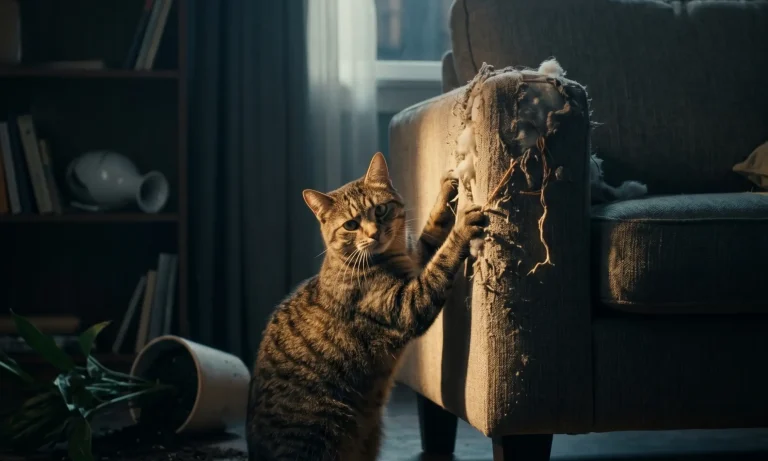
Cats scratch where your scent is strongest — the couch, the bed — because scratching is a scent-blending behavior. They are claiming the space alongside you, not destroying your furniture out of spite. Place the post in the same spot and that instinct becomes an asset.
The 3 AM Wake-Up Call: Why Ignoring Is Your Greatest Weapon
Few things test a cat owner’s patience like persistent meowing at the bedroom door in the middle of the night. The instinct is to yell, or — worse — to get up and feed them just to restore peace. Both responses send the same message: your noise-making worked.
Don’t say their name, don’t throw a pillow, don’t get out of bed. Any response — positive or negative — functions as a reward that reinforces the behavior.
A vigorous interactive play session 60–90 minutes before bed, followed immediately by their largest meal. This mimics the natural predatory cycle and signals the body to wind down.
With consistent silence at night and the pre-sleep play routine in place, most cat owners see a significant behavior shift within 10 days. The first three nights are the hardest — hold firm. Any single capitulation resets the clock.
The “Nevers” of Cat Training: Where Deterrent Becomes Damage
There is a meaningful difference between an unpleasant deterrent and a painful or frightening one. Effective cat training keeps your cat’s Mojo — their confidence and trust — fully intact. The methods below cross that line.
- Scruffing — Picking an adult cat up by the scruff of the neck is terrifying and unnecessary. It is not how feline mothers actually carry adult cats.
- Shock collars — These cause physical pain and have no place in a home training environment.
- Spiked or electric mats — If the surface would hurt your hand to touch, it does not belong under your cat.
- Physical discipline — Hitting, swatting, or throwing objects at a cat is a fast and irreversible path to a broken relationship.
Ask of any deterrent: does it make the environment feel unsafe, or does it make me feel unsafe? Only the former belongs in a well-designed training approach. A confident cat is a happy cat — and a happy cat is a well-behaved one.
Quick-reference summary
- Punishment teaches cats to fear you — not to stop the behavior. It creates stealth, not compliance.
- Environmental deterrents (sticky mats, motion-activated air canisters) let the space deliver the consequence, preserving your relationship.
- Every “No” must be paired with a nearby, high-value “Yes” — a sanctioned outlet for the same instinct.
- Scratching happens where your scent is strongest. Place the post beside the furniture, not across the room.
- Nighttime meowing requires complete silence as the deterrent and a pre-sleep Hunt–Catch–Kill–Eat routine as the Yes. Expect results in 10 days.
- Never use any tool that causes pain or exploits fear — it destroys Mojo, the foundation of all cooperative behavior.
Frequently Asked Questions About Cat Training
Cats don’t respond to verbal commands or corrections the way dogs do. When you yell or use punishment directed at your cat, they associate the discomfort with you — not with their action. Effective cat training works through consistent environmental signals and redirection, not authority.
Most cats show a noticeable behavior shift within 1–2 weeks when environmental deterrents (such as sticky mats or motion-activated air canisters) are paired consistently with a high-value nearby alternative, such as a cat tree at counter height reinforced with jackpot treats.
Spray bottles can suppress a behavior in the moment, but they don’t eliminate it. Cats learn to avoid the behavior only when you are present, and the technique erodes trust over time. Environmental deterrents that operate automatically — sticky mats, motion-activated canisters — are far more effective and preserve your relationship with your cat.
The No/Yes method pairs every behavioral deterrent (the “No”) with an appealing, physically close alternative (the “Yes”). For example: sticky tape on the sofa (No) combined with a scratching post placed directly beside it (Yes). The method works because it redirects natural feline instincts rather than attempting to suppress them.
Cats scratch where they smell their owner’s scent most strongly — sofas, beds, chairs — because scratching is a territorial scent-marking behavior. They are blending their own scent with their owner’s. Place the scratching post directly beside the furniture rather than in a remote corner, and use positive reinforcement to build the new habit.
Complete silence is the only effective deterrent — any response, including yelling, confirms the behavior works. Prevent it by establishing a Hunt–Catch–Kill–Eat routine before bed: vigorous interactive play 60–90 minutes before sleep, followed immediately by your cat’s largest meal. This mimics the natural predatory cycle and helps the body settle into rest. Most owners see a significant shift within 10 days of consistent application.
From Control to Partnership: A Different Frame
Living with a cat isn’t about being a boss — it’s about being a partner. When you move away from trying to control every move and instead embrace Catification and the No/Yes framework, you stop being the enemy and start being the provider of great alternatives.
Your cat isn’t being bad. They’re being a cat. Understanding that distinction — and meeting their instincts with sanctioned outlets rather than suppression — is the single most effective shift any cat owner can make. It changes the relationship from an adversarial one into a genuinely cooperative one.
Learning this new way to communicate is the very first “Yes” you can give your cat. What behavior is yours trying to tell you something about — and are you ready to listen?